


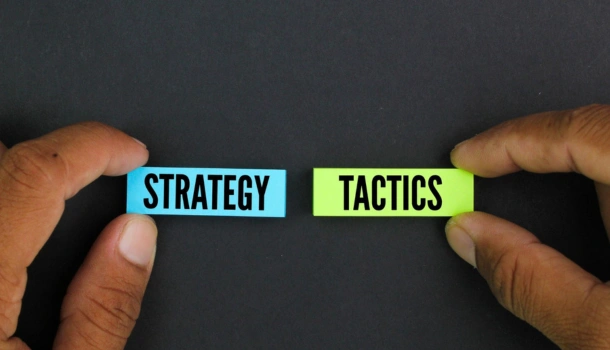
Strategy and tactics are often spoken about in the same breath, as if proximity implies similarity. In practice, they occupy very different psychological and organisational spaces. Strategy is where ambition lives. Tactics are where time is spent. The confusion begins when the two are treated as interchangeable, or worse, when activity is mistaken for intent.
In UK businesses, this confusion is rarely theoretical. It appears in meeting rooms where slide decks outline five-year visions while inboxes fill with urgent requests that have nothing to do with them. Strategy is usually written calmly, with distance and optimism. Tactics arrive noisily, demanding attention and resources now. The tension between the two is constant, and often unresolved.
Strategy is about choosing what not to do. This is uncomfortable, particularly in environments shaped by caution and consensus. It requires restraint, the confidence to decline opportunities, and the patience to wait. Tactics, by contrast, reward movement. They feel productive. They generate updates, metrics, and visible effort. In many organisations, tactical busyness becomes a substitute for strategic clarity.
The phrase “business execution” is where the argument usually lands. Leaders complain that teams fail to execute strategy, while teams insist the strategy keeps changing. Both are often right. Strategy without a believable path to execution becomes theatre. Tactics without a strategic anchor become noise.
I once watched a mid-sized firm rebrand itself twice in eighteen months while quietly abandoning the market it had originally set out to dominate.
In the UK context, this pattern is especially pronounced in growing companies. Early success is usually tactical. Someone finds a market gap, moves quickly, and adapts daily. Strategy emerges later, often under pressure from investors, lenders, or boards. When it does, it can feel imposed rather than earned. The language changes before behaviour does.
Large organisations face a different version of the same problem. Strategy becomes abstract, safely distant from daily operations. Tactics multiply to fill the gap. Teams optimise their own outputs without a shared sense of direction. Everyone is busy. Progress is harder to detect.
What makes this distinction difficult is that strategy and tactics influence each other. A strong strategy should inform which tactics are chosen. Effective tactics should test whether the strategy is sound. When the loop breaks, organisations drift. They continue moving, but not necessarily forward.
The UK has seen this play out repeatedly in public projects and private ventures alike. Programmes launched with clarity lose coherence as deadlines approach. Tactical compromises pile up. Eventually, the original strategy is unrecognisable, yet still referenced in speeches and reports. Execution becomes an exercise in justification.
The emotional difference between strategy and tactics is rarely acknowledged. Strategy feels hopeful. It promises future coherence. Tactics feel urgent and, at times, exhausting. People live inside tactics. They visit strategy. This imbalance matters. When employees cannot see how their actions connect to a larger plan, motivation erodes quietly.
At some point, I noticed that the teams most confident about their strategy spoke about it less, not more.
In well-run organisations, strategy acts as a filter. Not every opportunity passes through. Not every idea is pursued. Tactics are selected deliberately, not reactively. This requires discipline, and discipline is often mistaken for rigidity. In reality, it creates freedom. Teams know why they are doing what they are doing.
Business execution improves when strategy is treated as a living reference point rather than a static document. This does not mean constant revision. It means regular interpretation. Leaders explain how current decisions align with long-term intent. They show their working. This transparency builds trust.
Conversely, tactics should not be romanticised. They are tools, not virtues. Speed, responsiveness, and adaptability matter, but only in service of something larger. Without that, even the most efficient operation can head confidently in the wrong direction.
The UK business landscape, shaped by regulation, cautious investment, and complex stakeholder expectations, amplifies these challenges. Strategy must navigate uncertainty. Tactics must comply with constraints. The temptation is to let immediate pressures dictate direction. Over time, this turns strategy into a retrospective explanation rather than a guiding force.
There is also a language problem. Strategy is discussed in nouns: vision, position, advantage. Tactics live in verbs: launch, cut, expand, fix. Verbs feel more real. They dominate conversations. Without care, they crowd out the nouns entirely.
Understanding the difference between strategy and tactics is not an academic exercise. It determines how resources are allocated, how people are evaluated, and how success is defined. When performance is measured only through tactical outputs, strategic thinking withers. When strategy is celebrated but not operationalised, cynicism grows.
The most effective leaders I have observed treat strategy as a commitment rather than an aspiration. They accept that good tactics sometimes fail and bad ones sometimes succeed. They adjust without abandoning direction. This steadiness is rare, and quietly powerful.
In the end, strategy answers the question of where an organisation is trying to go. Tactics answer how it moves today. Confusing the two does not stop movement. It simply removes meaning from it.
